Krestyan Ivanovitch Rutenspitz
The DoubleKrestyan Ivanovitch Rutenspitz is an elderly doctor of medicine and surgery whose two appearances frame a stark change in Yakov Petrovitch Golyadkin’s circumstances. At their first meeting, he offers practical advice about health and company; at the end, he takes Golyadkin away in a carriage, an act presented through the patient’s mounting terror. The doctor’s return converts an earlier consultation into the image of an inescapable judgment, while leaving uncertain how much of that image belongs to the doctor’s authority and how much to Golyadkin’s disordered perception.
Identity and Introduction
Krestyan Ivanovitch is introduced by his professional title on the brass plate outside his consulting room: doctor of medicine and surgery. He is described as hale despite his age, with thick eyebrows, graying whiskers, expressive eyes, and distinguished orders on his breast. The room presents him in the settled routine of a practicing physician: he drinks coffee brought by his wife, smokes a cigar, writes prescriptions, and receives patients. His composure and professional standing contrast with the confusion of the visitor who arrives to consult him.
Golyadkin comes to see him at his flat on Liteyny Street, having rehearsed to himself that the visit is proper and that he can behave as though he is quite all right. The consultation is already a second meeting: Golyadkin apologizes for troubling the doctor again and asks his indulgence. Krestyan Ivanovitch’s professional identity is therefore established not only by his title and manner but by the treatment he has previously prescribed.
The Consultation and Its Limits
The doctor advises Golyadkin to follow the prescribed treatment and change his habits. He recommends entertainment, visits to acquaintances, cheerful company, and less hostility to drink. This advice points toward social engagement as part of the treatment, but Golyadkin answers by insisting that he lives as others do: he goes to the office by day, stays at home in the evening, can afford the theatre, and has his servant Petrushka. He repeatedly presents himself as ordinary and well, instead of taking up the doctor’s proposal or explaining what troubles him.
The mismatch between question and response becomes more pronounced when Krestyan Ivanovitch tries to draw out the problem. Golyadkin says in a frightened whisper that he has malignant enemies sworn to ruin him. The doctor tells him not to speak of enemies and urges him to sit down; he is sufficiently alarmed by Golyadkin’s outburst to try to settle him physically in an armchair. Yet when asked what is wrong, Golyadkin withdraws the subject. He says that the mask will fall from certain faces and something will come to light, but postpones disclosure until a more convenient time. The consultation ends with courtesy rather than explanation: Golyadkin takes his hat, wishes the doctor good morning, and apologizes for having troubled him, while Krestyan Ivanovitch says he sincerely wishes him well and will do what he can.
That exchange establishes the limits of the doctor’s access to his patient. Krestyan Ivanovitch offers an opportunity to describe distress, but Golyadkin gives him only fragments—claims of normality, an accusation of enemies, and a promise that hidden truths will emerge. The doctor’s advice remains concrete; the cause of Golyadkin’s fear remains undisclosed.
The Prescription Returns
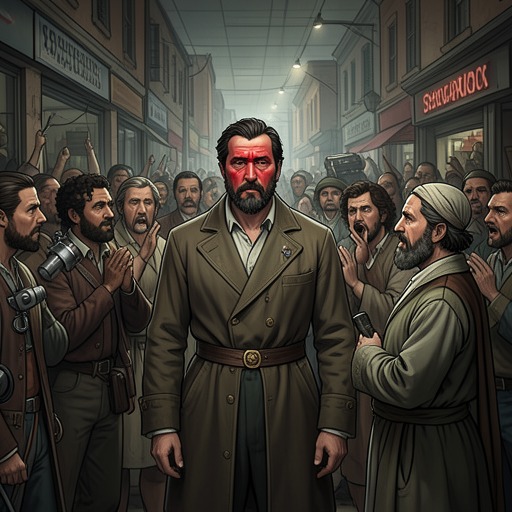
Four days after the prescription, Golyadkin encounters the medicine again in an unexpected setting. At a tavern, he reaches into his pocket for a handkerchief after the waiter asks to address him, but pulls out the bottle instead. The sight of the dark reddish liquid prompts a sudden conviction that his life is in danger. He drops and smashes the bottle, trembles, and becomes unresponsive as people gather around him. Then he pushes past those trying to detain him, rushes outside, and takes the first cab to his flat.
The episode does not establish that the medicine is dangerous: the threat is Golyadkin’s interpretation of the bottle, which he recognizes as the remedy Krestyan Ivanovitch prescribed. The prescription, originally part of ordinary medical care, has become an object of alarm. In the same sequence, an office attendant meets Golyadkin in his entry with an official envelope. Exhausted, Golyadkin says he knows it is official before he has inspected its contents, extending the scene’s atmosphere of dread from the medicine to the arrival of authority.
The Doctor’s Return and Golyadkin’s Removal
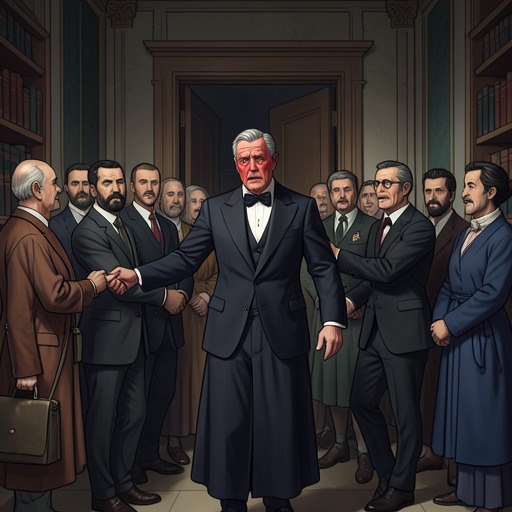
At the final gathering, Golyadkin sees his double’s apparent Judas kiss and imagines an unending series of identical Golyadkins bursting through the doors. Then the door opens and a tall, thick-set man in a black dress-coat, wearing a large cross and thick black whiskers, approaches him. The description recalls the doctor’s earlier appearance, but the closing scene makes the resemblance terrifying: Golyadkin recognizes the newcomer as Krestyan Ivanovitch and holds out his hand, while the man takes it and draws him away.
Golyadkin’s twin identifies the newcomer to him as the doctor, his old acquaintance. The twin’s malicious delight is set against the solemnity of the doctor’s manner: he fawns over the onlookers, takes a candle from a servant, and leads the way, while those in the drawing room crowd after the party. The repeated assurance that Golyadkin should not be afraid comes from the surrounding voices, but it does not calm him. On the brightly lit stairs, a crowd watches; Olsufy Ivanovitch sits on the top landing, observing the departure. Outside, a four-horse carriage waits, and the doctor gestures for Golyadkin to enter, with other people ready to help him in.
The carriage carries Golyadkin along an unfamiliar, deserted road bordered by dark patches of copse. After he has fallen into forgetfulness, he sees the doctor’s eyes in the darkness and doubts the identity of the man beside him: it is Krestyan Ivanovitch, yet, in his words, another and terrible Krestyan Ivanovitch. The doctor then declares that Golyadkin will receive free quarters, wood, light, and service, which he does not deserve. Golyadkin shrieks and clutches his head; the sentence confirms the destination as a punitive confinement in his frightened understanding, while the narrative gives no independent account of the doctor’s intention or the institution to which he is taking him.
Narrative Role and Significance
Krestyan Ivanovitch’s role is defined by the contrast between the ordinary structure of the first consultation and the menacing force of the final removal. At first, his directions—change habits, see acquaintances, keep cheerful company—are recognizably medical advice, and his response to the claim of enemies is an effort to calm Golyadkin. At the end, the same doctor’s face and authority appear inseparable from coercion. The reversal is sharpened by the return of recognizable details, especially the whiskers and the cigar associated with the earlier consulting-room scene, now transformed into signs in a vision of judgment.
The novel does not give Krestyan Ivanovitch an extended account of his own motives or inner life. Readers encounter him chiefly through Golyadkin’s embarrassed, suspicious, and ultimately terrified perception, though the doctor’s initial professional routine and measured speech also establish a practical identity independent of those fears. This difference in access matters: the final scene identifies him through the twin’s taunting explanation and Golyadkin’s recognition, but its supernatural menace is filtered through Golyadkin’s consciousness. The doctor thus remains both a real authority in the plot and the focal point of an unresolved transformation—from the physician asked for help into the figure who carries the protagonist away.